
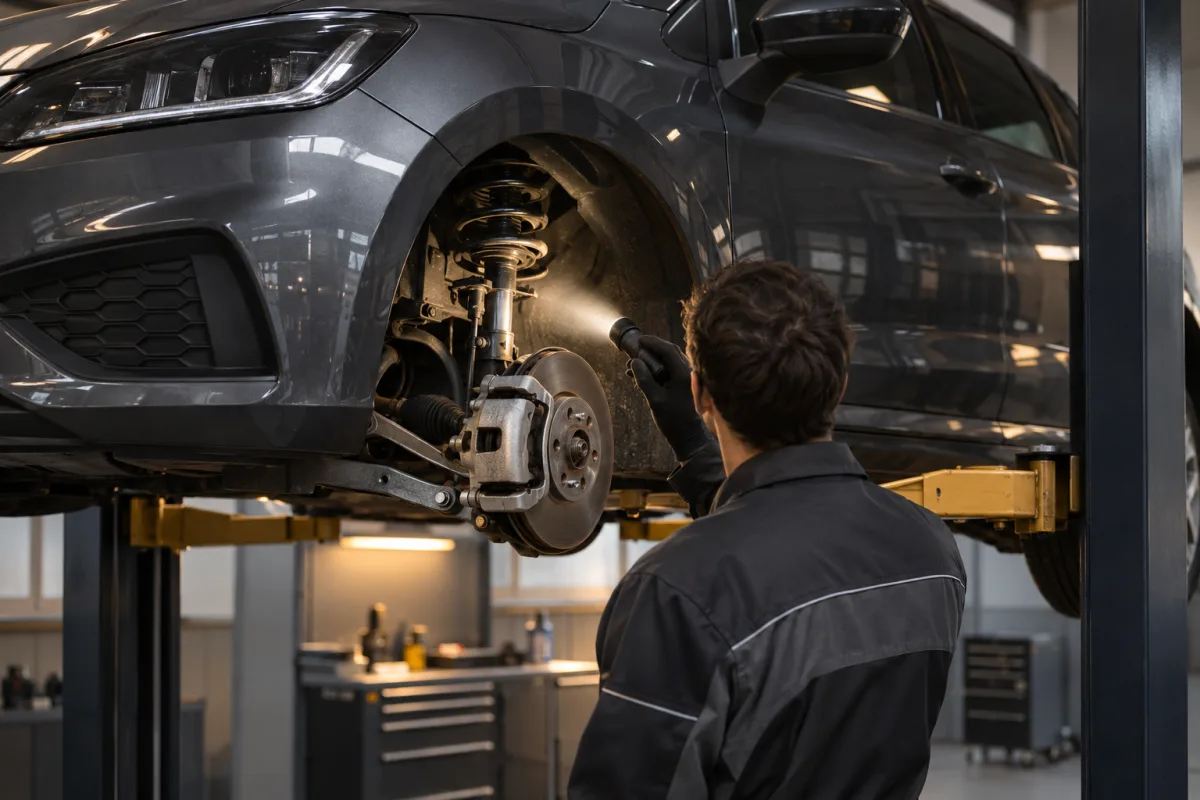
The essentials first
Ten inspection groups are mandatory, from the brakes to the chassis number.
The emissions test is part of the HU, and warning lights and the fault memory can be noticed.
Defects remedied before the inspection ends are entered by the inspector with the time.
What the HU actually checks
Almost everyone in Germany says “going to the TÜV”, but the official name is Hauptuntersuchung, the vehicle inspection (HU). It is carried out by officially recognised experts or test engineers, for example from TÜV, DEKRA, GTÜ or KÜS. The rules are the same for all of them: the vehicle must be roadworthy, environmentally compatible and compliant with regulations.
The StVZO names four test criteria. Design: is the part permitted and fitted correctly? Condition: is there damage, rust, wear or too much play? Function: does a process work correctly when you press a pedal or operate a lever or switch? Effect: are limit values met, for example for braking force? The inspection is non-destructive, so the inspector does not remove anything. For vehicles with their own braking system, it starts with a short drive at a minimum of 8 km/h.
The ten inspection groups of the HU
These groups are mandatory at every vehicle inspection. The bullet points show what the inspector looks at in each group on a car, in everyday language instead of official German.
Braking system
- Braking effect of the service brake on the test stand
- Parking brake (handbrake)
- Even braking force on the left and right
- Brake discs, drums and pads
- Brake lines and brake hoses
- Leak-tightness, brake booster and ABS
- Brake indicator and warning lights
Steering system
- Steering wheel and steering column
- Track rods, joints and steering gear (play, condition)
- Boots and covers
- Steering forces and ease of movement
- Power steering: function and leak-tightness
Visibility
- Windscreen and windows: cracks, stone chips in the field of view
- Prohibited films or stickers
- Rear-view mirrors: number, condition, permissibility
- Windscreen wipers
- Windscreen washer system
Lights and electrics
- Headlights and lamps: function and permissibility
- Headlight adjustment
- Indicators and hazard lights
- Brake, reversing, rear fog and number plate lights
- Reflectors
- Electrical wiring and battery
- Trailer socket
Axles, wheels, tyres, suspension
- Axles and axle suspension
- Springs and anti-roll bar
- Shock absorbers
- Wheels and rims
- Tyres: tread depth, damage, size and type as in the papers
- Bearings and joints for play
Chassis, frame, body
- Frame and load-bearing parts: rust, cracks, repairs
- Sills and floor pan
- Body and attached parts: fixing, condition
- Doors, bonnet and locks
- Towbar
- Spare wheel holder
- Drive, such as driveshafts and boots
Safety equipment
- Seat belts: condition, function, mounting
- Airbags, including the manufacturer’s replacement deadline
- Driving dynamics systems such as ESP
- Horn
- Speedometer
- Immobiliser and anti-theft device
- Warning triangle, hi-vis vest and first aid kit
Environmental impact
- Exhaust system: leak-tightness and noise
- Emissions test, with data readout for OBD vehicles
- Oil loss and other fluid loss
- Gas system for LPG or natural gas
- Electric and hybrid drive
- Ignition system and electronics (interference emission)
Passenger transport
- Only for buses, taxis and ambulances in commercial use
- For example emergency exits, fire extinguisher, taxi sign
- This group does not apply to private cars
Identification
- Vehicle identification number (FIN)
- Manufacturer’s plate
- Number plates front and rear
- Match with the vehicle papers, also after modifications
Basis: StVZO Anlage VIIIa, number 6. The list summarises the mandatory part in plain terms and does not replace the official defect catalogue. How a finding is classified is decided by the inspector on site.
Mandatory part and additional checks
The ten groups in the inspection catalogue are the mandatory part. The inspector may also look more closely at their own discretion if something stands out. The law expressly requires these additional checks when they are needed to assess road safety.
Two cases automatically make the HU more thorough: when the inspection appointment is overdue by more than two months, and when there is a suspicion of unauthorised technical modifications. If you let your sticker run out for a long time, you get more than trouble over the deadline: you also get a more detailed inspection.
A closer look
Minor defects
A sticker is possible, but the defects must still be remedied within one month at the latest.
Significant or dangerous defects
No sticker. Repair and return for re-inspection within one month of the HU date at the latest.
Unroadworthy
Driving on public roads is prohibited and the old sticker is removed.
Emissions test and fault memory
The emissions test is no longer a separate appointment but part of the HU, in the environmental impact group. For vehicles with on-board diagnostics, the inspector reads data from the engine and exhaust system through the diagnostic socket. The inspector can also query stored fault codes. Entries in the memory may be neither changed nor deleted.
Warning and indicator lights are part of the inspection too, for example for the brakes and airbag. A light that stays on after starting will be noticed. A workshop recognised for this may carry out the emissions part in advance as a separate part of the HU. The inspector then accepts its proof.
Electric cars, hybrids and LPG
For alternative drives, the StVZO lists its own inspection points in the environmental impact group: gas systems, hydrogen systems, the electric drive and the hybrid drive. For an electric car, the classic exhaust measurement does not apply. Brakes, suspension, lights and tyres are checked just as on a combustion-engine car.
For LPG or natural gas, the gas system is inspected. This gas system inspection may also take place beforehand in a recognised workshop as a separate part of the HU, at the earliest one month before the vehicle inspection. Bring the proof to the HU appointment.
Fix defects on the day of the inspection
If the inspector finds a defect that is remedied before the inspection ends, at the latest on the same calendar day, the inspector enters it in the report with the time. That is the practical advantage of having the HU at a workshop: a faulty bulb or a worn wiper blade is often replaced in a few minutes while the car is still there.
At Autodienst Kiel, TÜV SÜD carries out the vehicle inspection on Wednesdays and Saturdays right on site in Stockholmstraße. Bigger findings such as worn brakes or rust on load-bearing parts cannot always be solved on the same day. In that case the one-month deadline for the re-inspection applies.
- Take your registration certificate Part I (Zulassungsbescheinigung Teil I).
- Have proof for modifications ready, such as an expert report or operating permit.
- Carry a warning triangle, hi-vis vest and first aid kit.
- After starting, check that all warning lights go out.
- With a second person, check all lights around the car.
Still have a question?
Is the TÜV the same as the HU?
The inspection is called the Hauptuntersuchung (HU). TÜV is one of several organisations allowed to carry it out, alongside DEKRA, GTÜ, KÜS and others. The same rules apply everywhere.
Are the warning triangle and first aid kit checked at the HU?
Yes. Anlage VIIIa of the StVZO expressly lists the warning triangle, warning lamp, hi-vis vest and first aid kit in the safety equipment group.
Does the inspector remove parts?
No. The HU is non-destructive and works without removing vehicle parts. The inspector examines the car on the lift, on the brake test stand and through the diagnostic socket.
Do I have to get the emissions test done separately?
No, the emissions test (AU) is part of the HU. A workshop recognised for this may carry out the emissions part in advance, though. The inspector then accepts its proof.
Sources & further reading
- StVZO, Anlage VIIIa: carrying out and scope of the HU
- StVZO, Anlage VIII: defect categories and re-inspection
- ADAC: HU checklist