
The essentials first
Lights are the most common HU defect and you can check them yourself in a few minutes.
Tyres: at least 1.6 millimetres of tread, no damage on the sidewalls.
Brakes, suspension and underbody belong on the lift before the HU.
Why the self-check is worth it
According to the TÜV Report 2026, the dipped beam is the most common single defect at the HU, and the indicators are in the top 10 too. You can see both on a walk around the car in a few minutes. If you find such small things beforehand, at best you save yourself the second appointment.
You need no tools for this, only a second person who looks at the brake light and reversing light from behind. The list in the walk-round follows the route once around the car, then inside, under the bonnet and into the boot.
The walk-round before the TÜV
Once around the car, then inside, under the bonnet and into the boot. For the lights you need a second person.
Outside, around the car
- Dipped and main beam, sidelights
- Indicators front, rear, side, and hazard lights
- Brake light including third brake light
- Reversing and rear fog light
- Number plate light
- Number plates secure and legible
- Mirrors secure and undamaged
Windows and tyres
- Windscreen: cracks or stone chips in the field of view
- Wiper blades wipe without streaks
- Tread at least 1.6 mm, better more
- Tyre sidewalls without bulges, cuts, cracks
- Tyre size as in the papers
In the interior
- Warning lights go out after starting
- Belts pull out, latch and retract cleanly
- Horn works
- Washer system filled with water and sprays
- Handbrake holds the car on a slope
Engine bay and underbody
- Bonnet stays up on its own
- Check the date on the bonnet struts
- Bonnet latches securely when closed
- No oil stains on the parking spot
- Exhaust without rattling or unusual noise
Boot and papers
- Warning triangle and hi-vis vest
- First aid kit, mind the expiry date
- Registration certificate Part I
- Proof for unregistered modifications
- Removable towbar, if registered
- Proof of the gas system inspection for LPG
The walk-round does not replace an inspection on the lift. A workshop checks brakes, steering, suspension and underbody.
Tyres: more than just tread depth
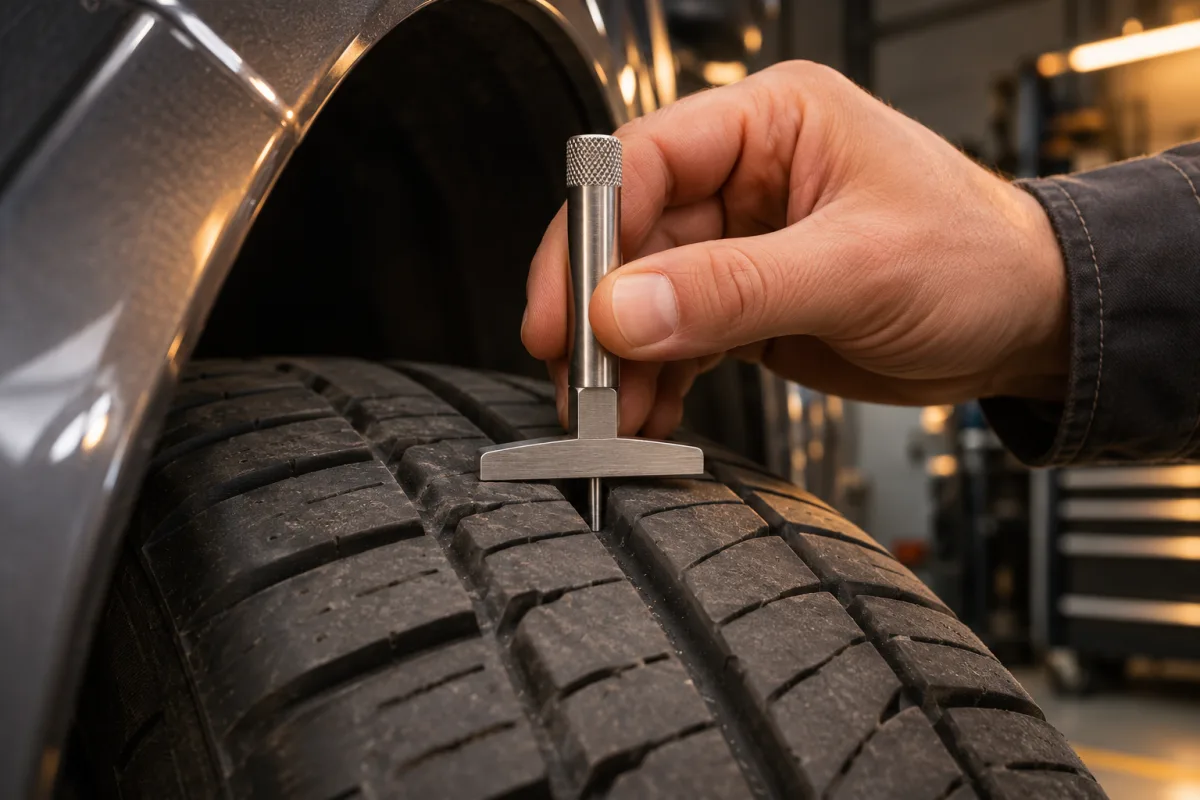
The legal minimum is 1.6 millimetres of tread. The ADAC recommends more: three millimetres for summer tyres and four for winter tyres. Measure in the main grooves, inside and outside, because tyres often wear on one side.
Look at the sidewalls too: bulges, cuts and cracks are defects regardless of the tread. The tyres must also match the vehicle papers or an approval in size and type. There is no fixed maximum age for car tyres at the HU, but the inspector objects to visible ageing cracks.
A closer look
Check yourself
Lights, tyres, windows, wipers, warning lights, belts, horn and accessories.
Have checked at the workshop
Brakes, steering, axles, springs, shock absorbers and rust on the underbody.
Bring with you
Registration certificate Part I and proof for modifications or the gas system.
Warning lights and fault memory
Start the engine and watch the displays. The warning lights for airbag, brakes, ABS and engine come on briefly when you switch on and must go out afterwards. If one stays on, it belongs in the workshop before the HU.
Clearing the fault memory shortly before the appointment does not help. The inspector reads the exhaust system through the diagnostic socket. After clearing, the self-tests of the emissions monitoring are reset, and the actual cause is still there.
Papers and accessories
The registration certificate Part I (Zulassungsbescheinigung Teil I), the vehicle registration document, is part of the HU. If you have modified the car, for example with different rims, lowering or a towbar, bring the expert report, parts report or operating permit, unless the change is already registered. A removable towbar that is registered belongs in the car.
Warning triangle, hi-vis vest and first aid kit are in the inspection catalogue. The ADAC advises also checking the expiry date on the first aid kit. If you drive on LPG, the gas system inspection may take place at the earliest one month before the HU; bring the proof.
What belongs on the lift
Some things you cannot judge from outside: the condition of brake discs and brake lines, play in the steering and axle joints, springs and shock absorbers, rust on sills and floor pan. That is exactly where most of the expensive surprises are.
An HU pre-check at the workshop covers these points. At Autodienst Kiel, TÜV SÜD inspects on Wednesdays and Saturdays right on site. What we find beforehand, we fix after talking to you, so the inspection appointment does not become guesswork.
- Switch through the lights with a second person.
- Look at the tread and sidewalls on all four wheels.
- Top up washer fluid and check the wiper blades.
- Watch the warning lights after starting.
- Put the warning triangle, hi-vis vest, first aid kit and registration document in the car.
Still have a question?
Which papers do I need for the TÜV?
The registration certificate Part I. Also proof for modifications that are not yet registered and, for LPG, the proof of the gas system inspection.
How much tread do tyres need for the HU?
Legally at least 1.6 millimetres. The ADAC recommends three millimetres for summer tyres and four millimetres for winter tyres.
Does it help to clear the fault memory before the HU?
No. The inspector reads the exhaust system through the diagnostic socket, and a freshly cleared memory stands out. The cause also remains.
Is a pre-check at the workshop worth it?
Especially for older cars. Brakes, suspension and rust on the underbody can only be judged on the lift, and that is where most of the bigger defects are.
Sources & further reading
- ADAC: HU checklist
- StVZO, Anlage VIIIa: carrying out and scope of the HU
- StVZO, Anlage VIII: gas system inspection and re-inspection