
The essentials first
According to the TÜV Report 2026, 21.5 percent of cars failed with significant or dangerous defects.
Dipped beam and brakes lead the defect list.
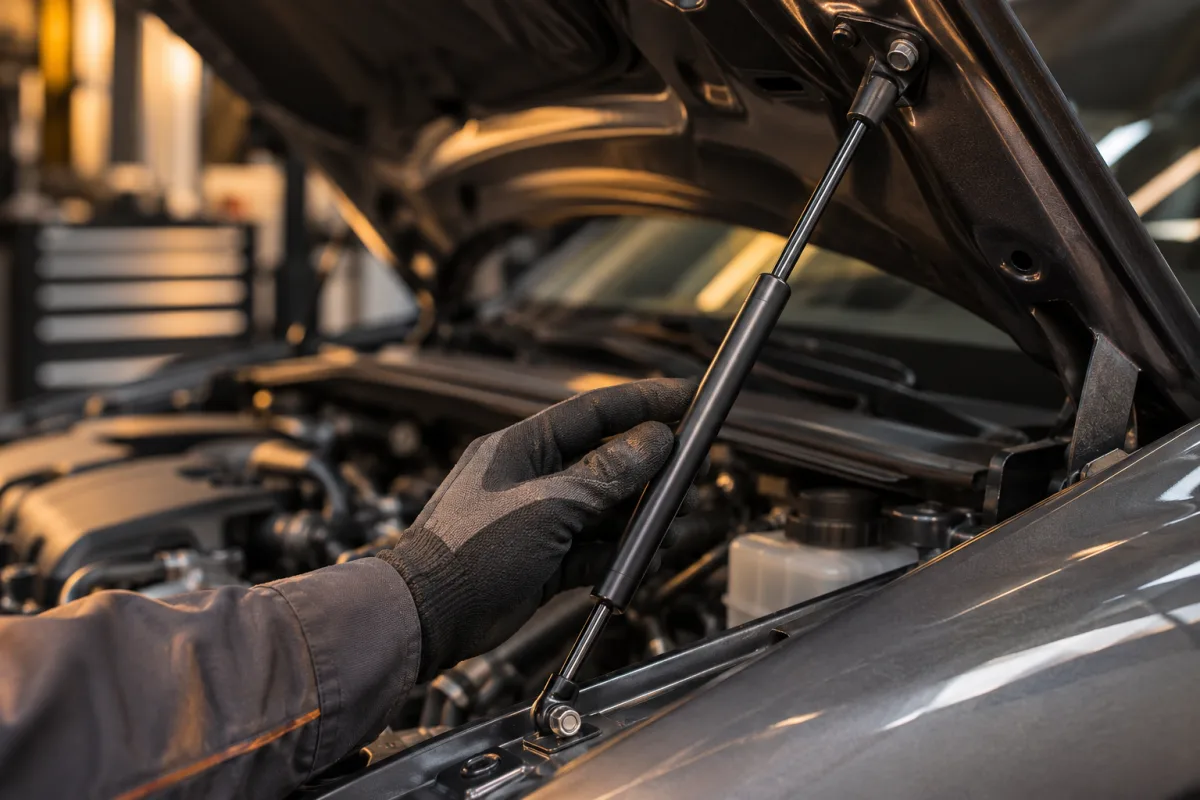
Expired bonnet struts can also cost you the sticker.
What the TÜV Report 2026 shows
For the TÜV Report 2026, the TÜV organisations (Germans call the vehicle inspection “TÜV”) evaluated around 9.5 million vehicle inspections on cars, carried out between July 2024 and June 2025. 21.5 percent of the cars failed with significant or dangerous defects, 0.9 percentage points more than the year before. Another 12.3 percent got their sticker with minor defects.
The ranking of individual defects is led by lights and brakes. These are parts that work every day and wear slowly. Many drivers therefore do not notice the wear until the inspector finds it.
The ten most common HU defects
The ranking of individual defects from the TÜV Report 2026, sorted by area. The number gives the place in the overall ranking.
Lighting
- Place 1: dipped beam
- Place 7: indicators
Braking system
- Place 2: brake discs
- Place 3: brake pads
- Place 4: brake lines
Axles, springs, tyres
- Place 5: suspension springs
- Place 6: tyres
- Place 10: shock absorbers
Leak-tightness and rust
- Place 8: oil loss at the engine
- Place 9: sills
Source: TÜV Report 2026, vehicle inspections from July 2024 to June 2025, ranking according to the report as given by autohaus.de.
Older cars fail much more often
The defect rate rises steadily with age. According to the ADAC evaluation of the report, 22.9 percent of eleven-year-old vehicles have significant defects, and after 15 years it is 32.9 percent, so around one car in three.
Age also plays the main role in the serious cases: around 12,000 cars were classed as unroadworthy and taken off the road immediately, and about 90 percent of them were at least ten years old. If you drive an older car, a pre-check before the HU gains you the most.
A closer look
Lights
Most common defect, usually quickly fixed if you find it before the appointment.
Brakes
Wear parts like discs and pads, and more work if the lines are rusty.
Rust on load-bearing parts
Sills and floor pan are often the most involved repair.
Unobvious reasons: bonnet struts, warning lights, small things
Not every refused sticker has to do with brakes or rust. One example is the gas pressure struts of the bonnet. On many newer cars they are part of the active bonnet, which lifts in a collision with a pedestrian. Many struts carry a printed replacement date, and one strut manufacturer recommends checking and replacing them every five years. According to the trade press, some inspectors rate expired struts as a significant defect and others do not. The inspection catalogue has no separate item for “bonnet struts”, so the assessment goes through bonnets and safety equipment.
Equally unobvious: an airbag warning light that does not go out after starting, a stone chip with a crack in the field of view, a faulty number plate light or a missing first aid kit. Each of these items is in the inspection catalogue.
Lights and brakes: the classics
With lights, the inspector mostly finds blown bulbs and wrongly adjusted headlights. Both are quickly fixed if you notice them before the appointment. With modern LED headlights, a faulty unit can be more involved, because the light source often cannot be replaced individually.
With brakes, inspectors mainly object to worn or badly rusted discs, worn pads and corroded brake lines. On the test stand it also shows when one side brakes more weakly than the other. Judder, squealing or a steering wheel that pulls when braking are signs you should take seriously beforehand.
How to avoid the second appointment
The annoying part of a refused sticker is rarely the repair alone but the second trip for the re-inspection. Two things help: a pre-check on the lift a few days before the HU, and an HU at a place that also does repairs. Defects remedied on the day of the inspection before it ends are entered by the inspector in the report with the time.
At Autodienst Kiel, TÜV SÜD carries out the HU on Wednesdays and Saturdays on site. We replace small things like a bulb or a wiper blade straight away. For bigger jobs we talk to you first.
- Switch through all lights with a second person.
- Mention judder, squealing or pulling when braking at the workshop.
- Watch for oil stains under your parking spot.
- Have the date on the bonnet struts read.
- Check that all warning lights go out after starting.
Still have a question?
Which defect is the most common at the HU?
According to the TÜV Report 2026, the dipped beam. Brake discs, brake pads and brake lines follow.
Are expired bonnet struts an HU defect?
They can be. The inspection catalogue has no separate item for them, but inspectors sometimes rate expired struts as a significant defect, especially on an active bonnet with pedestrian protection. Have the date on the struts read before the HU.
How many cars fail the TÜV?
In the TÜV Report 2026, 21.5 percent of cars had significant or dangerous defects and got no sticker. For 15-year-old cars it was around one in three.
What happens after failing?
You must have the defects remedied and present the car for re-inspection within one month of the HU date at the latest. If it has been classed as unroadworthy, you may no longer drive it.
Sources & further reading
- ADAC: TÜV Report 2026, results and defect rates
- autohaus.de: the most common HU defects
- auto motor und sport: gas struts as a TÜV risk
- StVZO, Anlage VIII: defect categories and re-inspection